
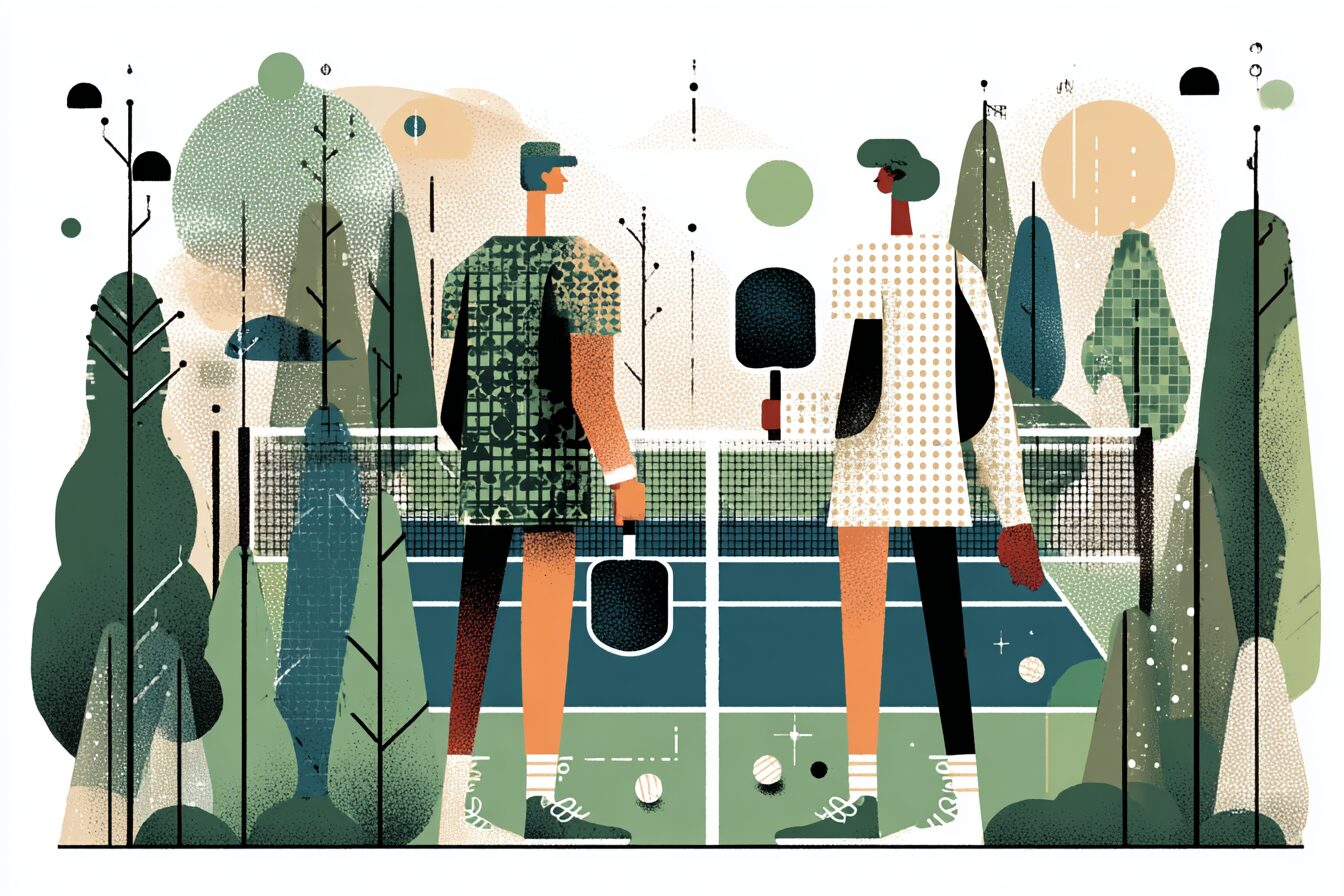
You’re roughly the same level. You like each other off the court. You’ve played together enough that you know each other’s game. And yet — something keeps going sideways and you and your pickleball partner clash.
Maybe it’s the side-by-side silence after a point goes wrong. The comment that lands harder than it was meant to. The feeling that you’re playing at each other instead of with each other. The way one of you shuts down and the other can’t figure out why.
You’ve tried talking about it. You’ve tried not talking about it. Neither works.
Here’s what most doubles advice misses: the problem isn’t your backhand. It’s not your footwork or your stacking strategy or who takes the middle ball. The tension you’re feeling is almost always a personality clash — two people with completely different internal wiring, put under competitive pressure, with no map for what’s happening.
That’s what this post is about. And once you see it, you can’t unsee it.
Why Pickleball Brings Out the Personality Problem
Pickleball is a doubles game. That’s not incidental — it’s the whole thing. Every shot you hit affects your partner. Every error lands in the space between you. Every point requires two people to make decisions, communicate, and recover together, in real time, without a timeout.
And here’s the thing about pressure: it strips away the polite version of yourself and leaves the core pattern.
The person who’s been managing their critical inner voice all week? Under pressure, it comes out sideways — directed at their partner instead of themselves. The person who needs control to feel safe? When the score slips, they start taking balls that aren’t theirs. The one who’s been performing confidence all game? When they miss the easy one, they go quiet — not because they’re fine, but because they don’t know how to be seen struggling.
None of this has anything to do with skill. It has everything to do with personality.
That’s the insight behind everything we do at Dink Deeper. We use a framework of nine pickleball personality types — each one a distinct pattern of strengths, blind spots, and stress responses — to help partners actually understand each other. Not just tolerate. Understand.
The 9 Pickleball Personalities (And How They Clash)
Here’s a quick orientation. Each type has a name, a core gift, and — crucially — a pattern that creates friction under pressure. This is what you need to know before we get into the specific clashes.
The Line Judge (Type 1) — Precise, principled, improvement-oriented. Under pressure: the inner critic gets loud, and sometimes it points outward. Partners feel evaluated, not supported.
The Rally Maker (Type 2) — Warm, generous, attuned to their partner. Under pressure: gives so much to the partnership that they lose their own game, then resent not being noticed.
The Closer (Type 3) — Driven, adaptive, laser-focused on winning. Under pressure: goes image-management mode — gets quieter, more controlled, subtly blames the partner in their head.
The Artist (Type 4) — Intuitive, emotionally deep, plays beautifully on a good day. Under pressure: mood swings that can feel inexplicable to a partner who just wants to play through it.
The Strategist (Type 5) — Analytical, observant, sees the whole board. Under pressure: retreats inward. Goes silent. Partner reads it as disengagement when it’s actually processing.
The Loyal Partner (Type 6) — Committed, perceptive, deeply reliable. Under pressure: anxiety spikes and they start scanning for everything that could go wrong — including things their partner did.
The Rally Cat (Type 7) — High energy, fun, spontaneous. Under pressure: impulse shots, premature pivots, energy that can feel chaotic to a steadier partner.
The Enforcer (Type 8) — Commanding, intense, protective. Under pressure: takes over — physically and emotionally — in ways the partner may experience as being crowded out.
The AnchPickleball Personality Type 9 | The Anchoror (Type 9) — Calm, steady, the partner everyone wants in a tight match. Under pressure: checks out — not dramatically, but quietly — in ways the partner notices before the 9 does.
These aren’t flaws. They’re patterns. And once you know the pattern, you can work with it instead of against it.
→ Not sure which type you are? Take the QUEST quiz here — it takes about two minutes.
The Clashes That Actually Show Up on the Court
Most doubles friction falls into one of a handful of recurring dynamics. Here are the most common — and what’s actually happening beneath the surface.
The Critic and the Sensitive One
The Line Judge + The Artist (Types 1 and 4)
The Line Judge notices everything. The grip angle on the third shot. The late reset. The point that was right there if you’d just stayed patient. They don’t say it to be cruel — they say it because they genuinely believe fixing it helps.
The Artist is processing. Not the technical error, but the emotional weight of the moment — the feeling of the game, the quality of the connection, what the miss means. They’re intuitive, and they feel criticism acutely. Especially when it comes right after the point.
What happens: The Line Judge offers a quick correction. The Artist goes quiet. The Line Judge interprets the silence as acknowledgment and moves on. The Artist is now carrying it. Two points later, the Artist makes another error — this time partially because they’re inside their own head — and the Line Judge has no idea what changed.
The real problem: Two completely different timelines for processing what just happened. The 1 is already on to the fix. The 4 is still inside the moment.
What actually helps: Line Judge — one beat before the feedback. Artist — tell your partner you need a second before you can hear the note. (Yes, out loud. Yes, during the match.)
The Driver and the Person Who Checked Out
The Closer + The Anchor (Types 3 and 9)
This is one of the most common pairings — and one of the trickiest. The Closer is goal-oriented, reads momentum, and has opinions about how every point should be played. The Anchor is calm, steady, and genuinely happy to follow the Closer’s lead.
Until they’re not.
What happens: The Closer wants to run a specific strategy. They explain it quickly — maybe too quickly — and the Anchor nods. But something was missed, or the Anchor has a different read they didn’t voice. Halfway through the match, the Anchor starts playing slightly off-script without saying anything. The Closer notices and gets tighter. Their energy becomes controlling. The Anchor reads the tightening, dislikes the pressure, and subtly withdraws further.
Both players feel like they’re playing alone.
The real problem: The 3 assumes alignment was reached because no one objected. The 9 didn’t object because they don’t love conflict — even productive conflict. The gap between them grows silently.
What actually helps: Before the match, 3 asks specifically: “What do you want to own today? What do you want me to call?” The 9 needs a concrete role — not implicit permission, but explicit assignment.
→ We wrote a full Court Chemistry deep-dive on this pairing. Read it here.
The Anxious One and the Loose Cannon
The Loyal Partner + The Rally Cat (Types 6 and 7)
This one is exhausting for the 6 and baffling for the 7.
The Loyal Partner is paying attention to everything. Your body language. The score. The pattern the opponents are running. The shot you just took that went out — was that a fluke or is that a thing now? They’re not anxious because they’re weak; they’re anxious because they’re thorough. They want to know the plan so they can trust it.
The Rally Cat is having a great time. They’re adapting on the fly, feeling the game, going for shots because the moment felt right. They don’t understand why their partner seems so tense — they’re up 5-3, this is fun!
What happens: The 7 goes for a low-percentage flick winner at a critical moment. It misses. The 6 doesn’t say anything, but their shoulders shift. The 7 notices and makes a joke to lighten it. The 6 doesn’t laugh. Now both players are distracted — the 6 by their anxiety that the 7 will go rogue again, the 7 by the feeling that their partner doesn’t trust them.
The real problem: The 7’s spontaneity is the exact thing that makes the 6’s nervous system light up.
What actually helps: Before the match: “When we’re down, we reset to dinks until we break serve. I’ll relax — I promise — if I know that’s our anchor.” The 7 needs a constraint they’ve agreed to. The 6 needs to know there’s a plan.
The One Who Takes Over and the One Who Disappears
The Enforcer + The Strategist (Types 8 and 5)
The Enforcer plays big. Physically big — they cover court, they hit hard, they move with authority. When things go wrong, they get more decisive, not less. It’s not aggression exactly; it’s their version of taking care of things.
The Strategist plays precisely. They’ve read the opponents, they’ve seen the pattern, they have a plan. But when the Enforcer starts running over that plan — poaching balls the 5 called, overriding shot selections mid-rally — the 5 doesn’t fight back. They go quiet. They pull their energy inward.
What happens: The 8 thinks they’re helping. The 5 is quietly building a case. By the end of the match, the 5 has a detailed mental log of every moment the 8 took over. The 8 has no idea any of this is happening. The 5 goes home feeling used. The 8 goes home thinking it was a decent match.
The real problem: Two different definitions of teamwork. For the 8, teamwork means putting the best player in the best position to win. For the 5, teamwork means honoring the plan you agreed on.
What actually helps: Pre-match clarity: “When you call it, I trust it. When I call it, you trust it. Middle ball — first one to call it, owns it.” The 8 can agree to this. They just need it stated explicitly.
The Feedback Loop That Never Ends
The Line Judge + The Line Judge (Types 1 and 1)
Same-type pairings have a particular texture — and with two 1s, the shared standard that makes them a great team in theory becomes the thing that grinds them down in practice.
What happens: Neither player is going to let a mistake slide. Both players are tracking errors — their own and their partner’s. After a close loss, the debrief begins immediately: “You were taking too many third shots,” “I noticed you weren’t resetting when we were under pressure.” Both of them meant it constructively. Both of them are now walking to the car feeling quietly criticized.
The real problem: No soft landing in the team. High standards without a release valve creates compound pressure.
What actually helps: Pre-match rule: one thing per point, then it’s done. No cumulative tallies. The standard is still there — it just can’t run both directions simultaneously.
What’s Actually Happening Under the Surface
Every one of these clashes follows the same basic structure: two people with different internal wiring, under pressure, defaulting to their core pattern — and interpreting their partner’s pattern as a problem.
The Line Judge isn’t trying to make you feel small. Their inner critic is loud, and it leaks.
The Closer isn’t cold — they’ve just learned to perform okay when they’re not.
The Anchor isn’t checked out. They’re processing in a way that looks like absence.
The Enforcer isn’t trying to take your game. That’s how they protect people they care about.
When you understand this — when you have a framework for what’s happening — the friction stops feeling personal. Which is the first step toward actually changing it.
How to Use This Framework With Your Pickleball Doubles Partners
You don’t need to psychoanalyze your partner between games. You just need a few things:
1. Know your own type. The hardest part is usually admitting your own pattern — the ways you contribute to the dynamic. The QUEST quiz will tell you your type, but the real work is reading the shadow side and nodding instead of flinching.
2. Notice the trigger. Every pairing has a recurring trigger — a specific situation where the friction tends to spike. For the 3 and 9, it’s when the score slips. For the 6 and 7, it’s when the 7 deviates from the plan. Knowing the trigger lets you prepare for it instead of reacting to it.
3. Build one pre-match ritual. The pairings above each have a “one thing to say before you play.” These aren’t magic — they’re just ways to establish shared understanding before the pressure starts. Pre-match agreements work because they bypass the in-match emotional reaction and operate at the level of trust.
4. Stop solving for the symptom. If you keep arguing about who covers the middle, the middle isn’t the problem. The middle is the symptom. The problem is usually something about control, recognition, or trust — and that’s a personality conversation, not a strategy conversation.
The Deeper Truth
Here’s what I’ve found, building this framework and watching it play out on courts and in partnerships:
The clashes that feel like pickleball problems are almost always relationship problems wearing pickleball clothes. And the relationships that struggle off the court usually have the same underlying dynamic — the same misread of a partner’s silence, the same pattern of one person taking over and the other retreating, the same loop of critical feedback and defensive withdrawal.
Pickleball just turns up the volume. It makes visible what’s usually quiet.
Which means it also gives you a laboratory. A place to watch yourself under pressure, notice what comes out, and decide whether that’s who you want to be. A place to understand your partner in a way that daily life doesn’t force.
That’s what this platform is built for.
Ready to Go Deeper?
Find your type: Take the QUEST quiz — two minutes, nine types, one honest result.
Understand your pairing: Explore Court Chemistry — deep dives into specific type pairings, how they work, where they clash, and what to do about it.
Build your partnership: Join the Partnership Lab waitlist — a compatibility tool in development that maps your pairing dynamics and gives you specific communication strategies based on both your types.
Because the goal isn’t a perfect game. The goal is a better partnership — on the court, and everywhere else.
Dink Deeper uses a framework of nine pickleball personality types to help players understand themselves and their partners. Our QUEST quiz identifies your type in about two minutes. All nine types are explored in depth in our type profile series.
Leave a Reply