
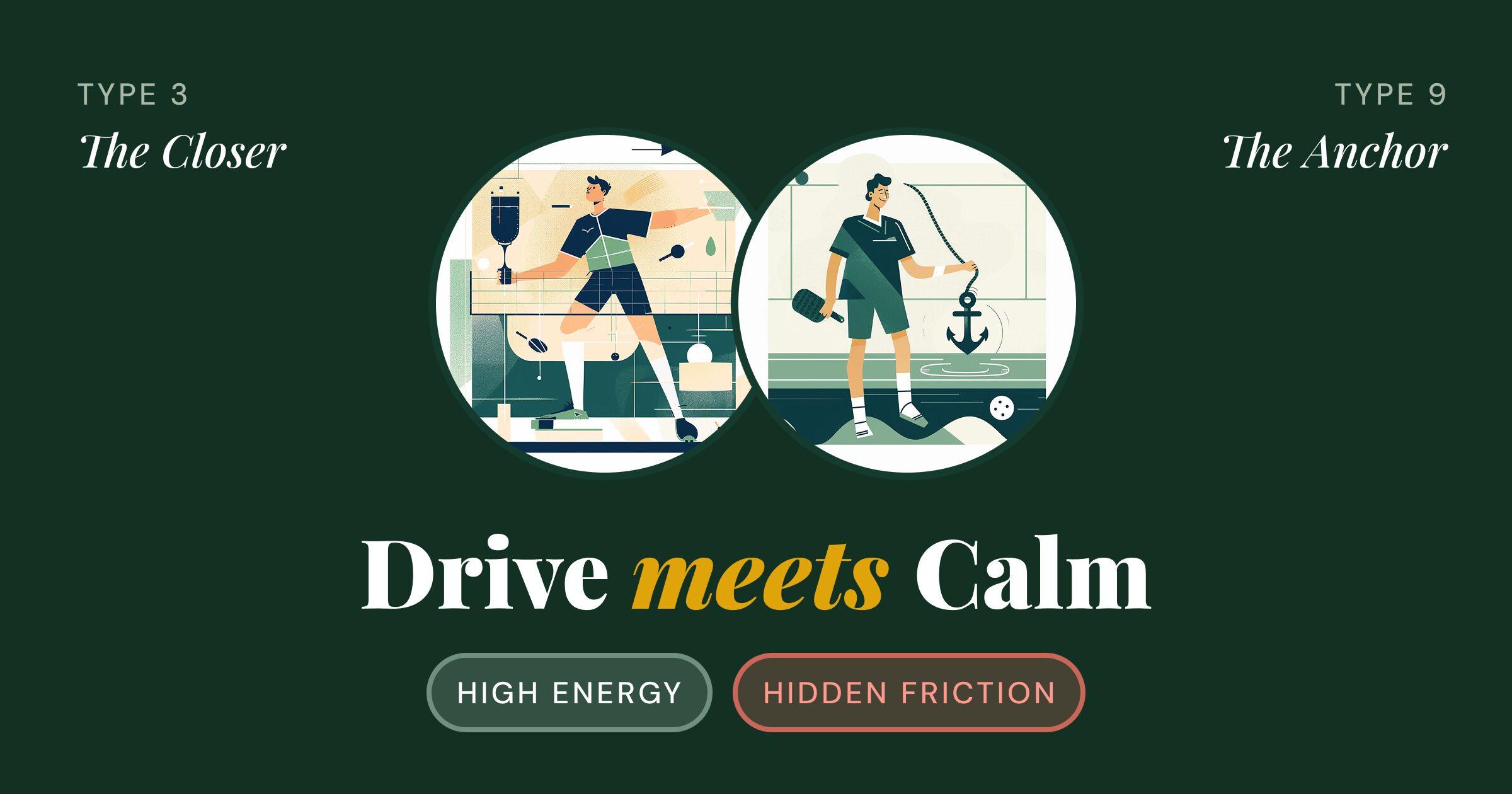
Court Chemistry Series · Type 3 × Type 9
They’ve been partners for three months, and every week the pattern is the same.
Sam serves, gets the ball back short, and immediately starts pressing — faster tempo, harder drives, trying to manufacture something out of nothing. Riley, on the other side of the court, resets calmly. Drops the third shot perfectly into the kitchen. Waits.
Sam can’t tell if Riley is fully in it.
Riley can tell Sam is trying to carry the whole team.
Neither says anything. They go up 10–7. Sam closes it out with a backhand drive down the line that catches the top of the tape and lands in. Sam pumps a fist. Riley smiles.
After the match, a player from the next court over says, “You two are fun to watch — you balance each other out perfectly.”
Sam and Riley both nod. Then, walking to the water cooler, Sam quietly wonders: does Riley actually care about winning? And Riley quietly wonders: does Sam realize I was running this whole time?
So What’s Actually Happening Here?
The Closer is the person who came to win. Not in a obnoxious way — just in a wired, deep-down, always-keeping-score way. They’re competitive, driven, and quietly performing even when they tell themselves they’re not. They read the scoreboard constantly. They adapt fast. They don’t know how to coast.
The Anchor is the person who came to play — and to keep things good. They’re steady, calm, and genuinely not rattled by much. They have opinions and instincts, but they don’t need to broadcast them. They’re present without being loud about it.
Put these two together, and the court dynamic is immediately legible: one player creates momentum, the other sustains it. One pushes forward, the other holds the ground. It looks like a natural partnership — and it is. But there are a few things going on underneath that are worth naming.
The Closer on the Court
The Closer’s best quality as a partner is their drive. When you’re down 8–4 and most people are mentally conceding, the Closer is recalibrating. They’re already thinking about what to change, who to target, how to turn it around.
But that same drive has a shadow side. Under pressure, the Closer’s intensity can shift from we need to execute better to I need to carry this. They start poaching shots that are their partner’s. They call the strategy mid-rally without checking in. They perform composure so effectively that their partner can’t tell whether they’re fine or spiraling.
The Closer doesn’t always realize they’re doing any of this. They’re just competing.
The Anchor on the Court
The Anchor’s best quality as a partner is their steadiness. They don’t add emotional static. They don’t spiral when the team falls behind. They reset between points with a consistency that more reactive players spend years trying to learn.
But that steadiness can read as something it isn’t. When the Anchor goes quiet mid-match — focused, locked in, running their own read of the game — their partner may interpret it as absence. As not caring. As just going along for the ride.
The Anchor is in the match. They just don’t announce it. And that’s the thing that costs them, not because they’re wrong, but because their partner doesn’t know what’s available.
A Match You’ve Probably Seen (or Lived)
Here’s the match that defines this pairing when it goes sideways.
They’re up 9–6 in the third game. The Closer starts pressing — going for cleaner winners, upping the tempo, trying to close it out. The Anchor settles into steady, reliable play. Drops, resets, dinks.
The Closer reads this as the Anchor not stepping up when it matters.
What’s actually happening: the Anchor is playing the highest-percentage pickleball of the match. They’re constructing the point, not finishing it — and they’re waiting for the Closer to take the shot when it opens up.
They lose the next three points because the Closer is taking low-percentage shots and the Anchor, not wanting to create conflict mid-match, doesn’t say anything.
They close it out eventually — 11–9 — but walk off a little tight. The Closer feels like they won it despite their partner. The Anchor feels like they played well and got no credit.
Both are partially right. Neither is the villain.
When the Pressure Hits
When things get tight, the Closer’s instinct is to do more. More pace. More shots. More audible adjustment-making. They can fill the whole emotional space of a partnership without meaning to, leaving the Anchor with less room than they need.
When things get tight, the Anchor’s instinct is to hold steady and wait. Which is exactly right — and exactly invisible. From the outside (including from their partner’s perspective), stillness under pressure can look like disengagement.
The real tension: the Closer needs to feel like they’re with someone. The Anchor’s steadiness is genuinely there — but it needs to be made legible.
When They’re Playing Their Best Game
When this pairing is clicking, it’s one of the most naturally complete dynamics in the game.
The Closer is doing what they do best — reading the opponent, creating pace, making the hard shot when it counts. They’re trusting their instincts and executing.
The Anchor is doing what they do best — holding the middle, resetting when the Closer overcooks something, providing a calm and reliable presence that makes the whole team feel stable.
And crucially: the Closer knows the Anchor is in it. Not because the Anchor changed anything — but because they’ve established the language for it. A word before the match. A small signal between points. Nothing dramatic. Just enough.
When the Anchor feels trusted, they contribute more explicitly. When the Closer feels grounded, they press less and execute more. The 3 still closes. The 9 still anchors. And somehow the sum is bigger than either part.
Practical Takeaways
Your drive is your gift — and the thing that most needs managing in a partnership. Check in on the instinct to take over when things get hard. Your Anchor partner is almost certainly more engaged than they look. Ask before you assume. And before a tough match, tell them explicitly: “Your calm is the plan.” You mean it as strategy. They’ll hear it as trust. Both are true.
Your steadiness is genuinely valuable — and it needs to be visible. “Present but silent” is a valid internal state; it’s a frustrating one for your partner to interpret. You don’t have to perform engagement. But you do need to signal it. One thing said between points — a read, a reset word, a “we’re good” — changes everything. The Closer doesn’t need you to be louder. They need to know you’re in the match with them.
The reframe for both:
This pairing works because you’re different — not despite it. The Closer brings what the Anchor doesn’t naturally access: urgency, drive, the ability to make something happen. The Anchor brings what the Closer can’t sustain alone: stillness, continuity, the patience to let the right shot come. Neither is incomplete. Both are better together than they’d be apart.
The “Hidden Friction” in this pairing isn’t hostility. It’s the gap between what’s actually there and what’s being communicated. Close the gap — just a little — and you get the Growth Pairing it was always supposed to be.
Try the Partnership Lab
Curious how your specific pairing plays out? The Partnership Lab breaks down your court chemistry in full — what works, what creates friction, and the one thing to say before you play.
Don’t know your type yet? → Take the QUEST
Leave a Reply