
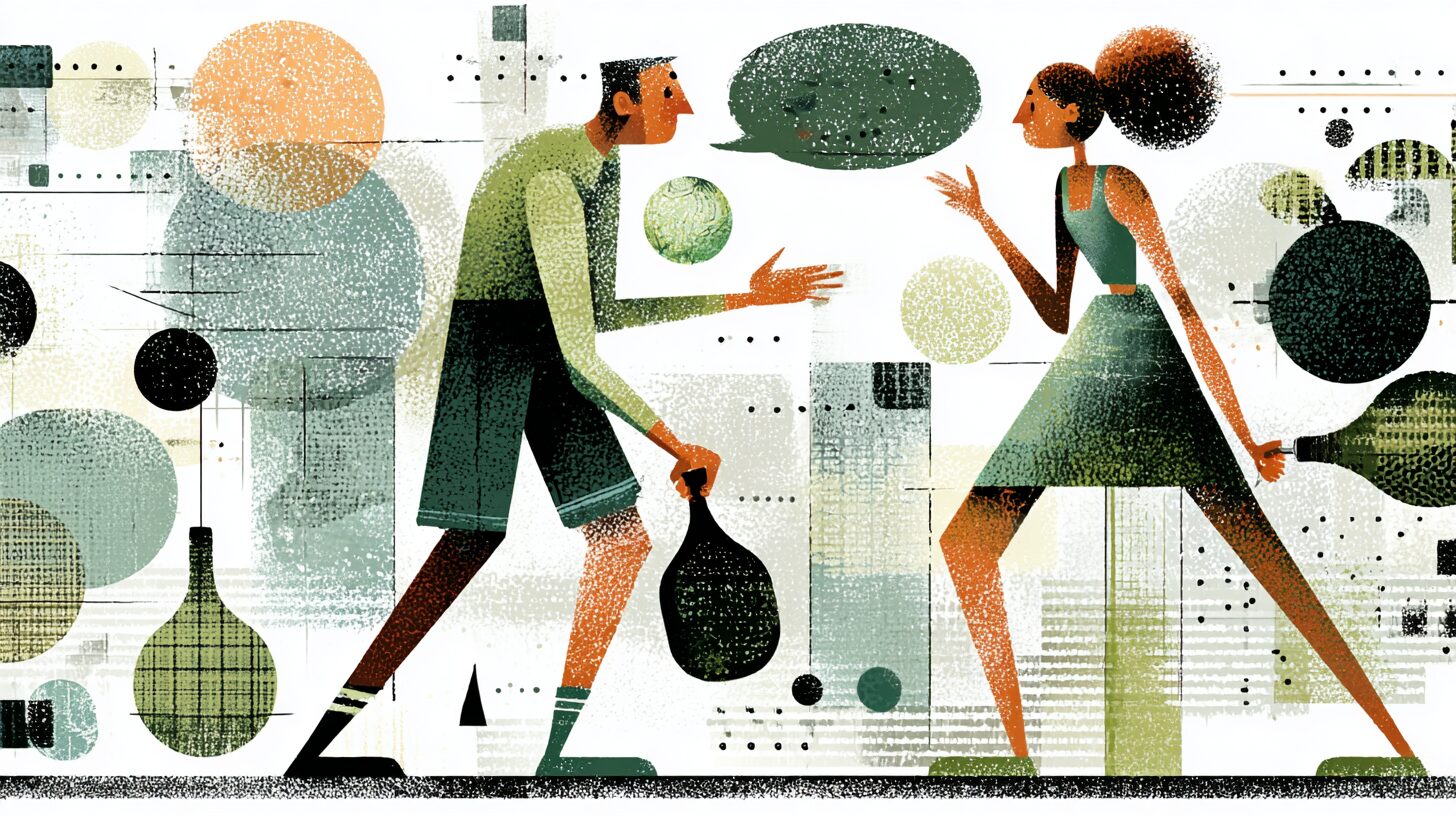
Knowing how to communicate with your pickleball partner is one of the most underrated skills in doubles — and almost nobody talks about it. Most advice stops at ‘call your shots‘ and ‘stay positive.‘ But your partner isn’t just a player. They’re a person. And the way they receive feedback, handle pressure, and process mistakes is shaped by something deeper than technique. It’s shaped by personality.
The game is tied. Your partner just missed an easy volley — the third one in a row. You glance over. They won’t meet your eyes.
What do you say?
If you’ve played doubles for any amount of time, you know this moment. And you probably know that whatever you say next can either hold the partnership together or quietly crack it.
That’s what we’re exploring here: how to actually reach your partner — not with generic encouragement, but with the specific language that lands for their type.
Why “Stay Positive” Isn’t a Communication Strategy
Here’s the thing about doubles partners: they fail in patterns. The same shot they overhit at 8-8 in the third game, they overhit last Tuesday. The way they go silent when the score is close — that’s not new either.
Most players absorb that frustration and either say too much or say nothing. Both tend to make it worse.
What’s missing isn’t more communication. It’s the right communication — delivered in a way your partner can actually receive.
That requires knowing who you’re talking to.
The 9 Pickleball Personalities — A Quick Primer
At Dink Deeper, we’ve identified nine distinct pickleball personalities — each one shaped by a core motivation, a set of natural strengths, and a predictable pattern under pressure. Take the QUEST quiz to find yours.
But right now, let’s talk about what actually happens when the game gets hard — and what each type needs to hear from a partner.
The Line Judge (Type 1) — They’re Already Harder on Themselves Than You Are
When a Line Judge makes a mistake, they’ve already catalogued it, dissected it, and assigned blame — to themselves. Silence from you registers as agreement. They assume you noticed, and you’re keeping score right alongside their inner critic.
What to say: “That was mine to call — let’s reset.” Redirect the accountability away from them and give them a shared responsibility to step into rather than a personal failure to sit in.
What NOT to say: “It’s fine, don’t worry about it.” They don’t believe you, and now they think you’re managing them.
The Rally Maker (Type 2) — They Need to Know the Partnership Is Okay
The Rally Maker tracks your body language, your tone, whether you made eye contact after that last point. When you go quiet because you’re concentrating, they wonder if you’re upset. When you’re visibly frustrated, they feel responsible — even if the mistake wasn’t theirs.
What to say: “We’re good — I’ve got you out here.” Affirm the relationship, not just the play. They can rally through anything if they know the partnership is intact.
What NOT to say: Silence. Silence is the worst thing. Say something.
The Closer (Type 3) — They Go Silent When Losing Because It Threatens Their Identity
The Closer isn’t spiraling emotionally — they’re recalculating. They went quiet because losing feels like a story about who they are, and they’re trying to rewrite it in real time. What they need isn’t reassurance. They need to be reminded of their competence in specific terms and given a path back.
What to say: “You know how to close — do it.” Give them a role. Give them a path to being the person who turns it around.
What NOT to say: “Stop trying so hard.” To a Type 3, there is no such thing.
The Artist (Type 4) — They Need to Feel Like the Struggle Means Something
When things go sideways, the Artist doesn’t just experience a bad stretch — they experience it as evidence. Evidence about their place in the game, their identity, whether this is really their thing. What they need isn’t reassurance. They need acknowledgment that the difficulty is real.
What to say: “That stretch is teaching us something — stay with me.” You’re not dismissing the difficulty. You’re reframing it as information rather than verdict.
What NOT to say: “Just shake it off.” You may as well ask them to be a different person.
The Strategist (Type 5) — They’re Already Analyzing. Let Them.
The Strategist goes quiet during a loss for a completely different reason than a Closer does. They’re not spiraling — they’re solving. They’re watching the pattern, identifying the adjustment, preparing to implement it. The worst thing you can do is interrupt that process with emotional noise.
What to say: “What are you seeing?” Ask for the analysis. Make them the expert in the moment.
What NOT to say: “Come on, let’s go, we need to wake up!” Energy escalation is counterproductive. They’ll shut down further.
The Loyal Partner (Type 6) — They Catastrophize Quietly and Need a Steadying Presence
When the score gets tight, the Loyal Partner runs scenarios. They’re not pessimists — they’re contingency planners. But when the contingencies start feeling more real than the game, they can spiral into hesitation. They need clarity and structure more than encouragement.
What to say: “I’ve got the middle — you cover your line. We’ve done this before.” Specific roles, shared plan. They can execute anything if they know what they’re responsible for.
What NOT to say: “Ugh, how did we let them catch up?” You just confirmed the catastrophe. Now they’re managing both the score and your emotions.
The Rally Cat (Type 7) — They’ll Joke Through a Loss. Let Them. Mostly.
The Rally Cat defuses tension through lightness — it’s not avoidance, it’s how they stay loose and in their body. But sometimes the humor becomes a way of not dealing with what’s actually happening. The key is matching their tone while still holding them accountable.
What to say: “Love the energy — can we also make one adjustment?” You’re not shutting down the lightness. You’re redirecting it.
What NOT to say: “Can you be serious for one second?” You just made the court feel like a job.
The Enforcer (Type 8) — They Don’t Want Softness. They Want Realness.
The Enforcer respects directness above almost everything. When you sugarcoat a problem or try to manage their emotions, they feel patronized. When they’re losing, they don’t want to be soothed. They want a plan — delivered straight.
What to say: “Here’s what I’m seeing — here’s what I think we change.” Direct, specific, no hedging.
What NOT to say: “It’s okay, it’s just a game.” It’s not just a game to them, and they know you don’t mean it either.
The Anchor (Type 9) — They’re Absorbing Everyone’s Energy. Help Them Come Back to Themselves.
The Anchor doesn’t crack under pressure the way other types do — they drift. When the court gets tense, they accommodate, smooth things over, pull back from the aggressive shot, try not to take up too much space. They disappear by degrees.
What to say: “I need you present right here, right now.” Not “wake up” — that implies failure. Grounded, direct, specific.
What NOT to say: “You’re so passive!” They already know. Shame doesn’t unlock a Nine — it sends them further inward.
The Real Communication Skill
Notice what almost none of these have in common with the usual doubles advice.
It’s not about volume. It’s not about positivity. It’s not about calling your shots louder or high-fiving between every point.
It’s about knowing what story your partner is telling themselves when things go wrong — and knowing the one sentence that interrupts that story and brings them back.
That’s the actual soft game.
Want to know your partner’s type? Send them to the QUEST quiz and see where they land. Then come back here.
We’ll be here.
Find your own pickleball personality → Take the QUEST Quiz Curious how your pairing plays out? → Try the Partnership Lab
Leave a Reply