
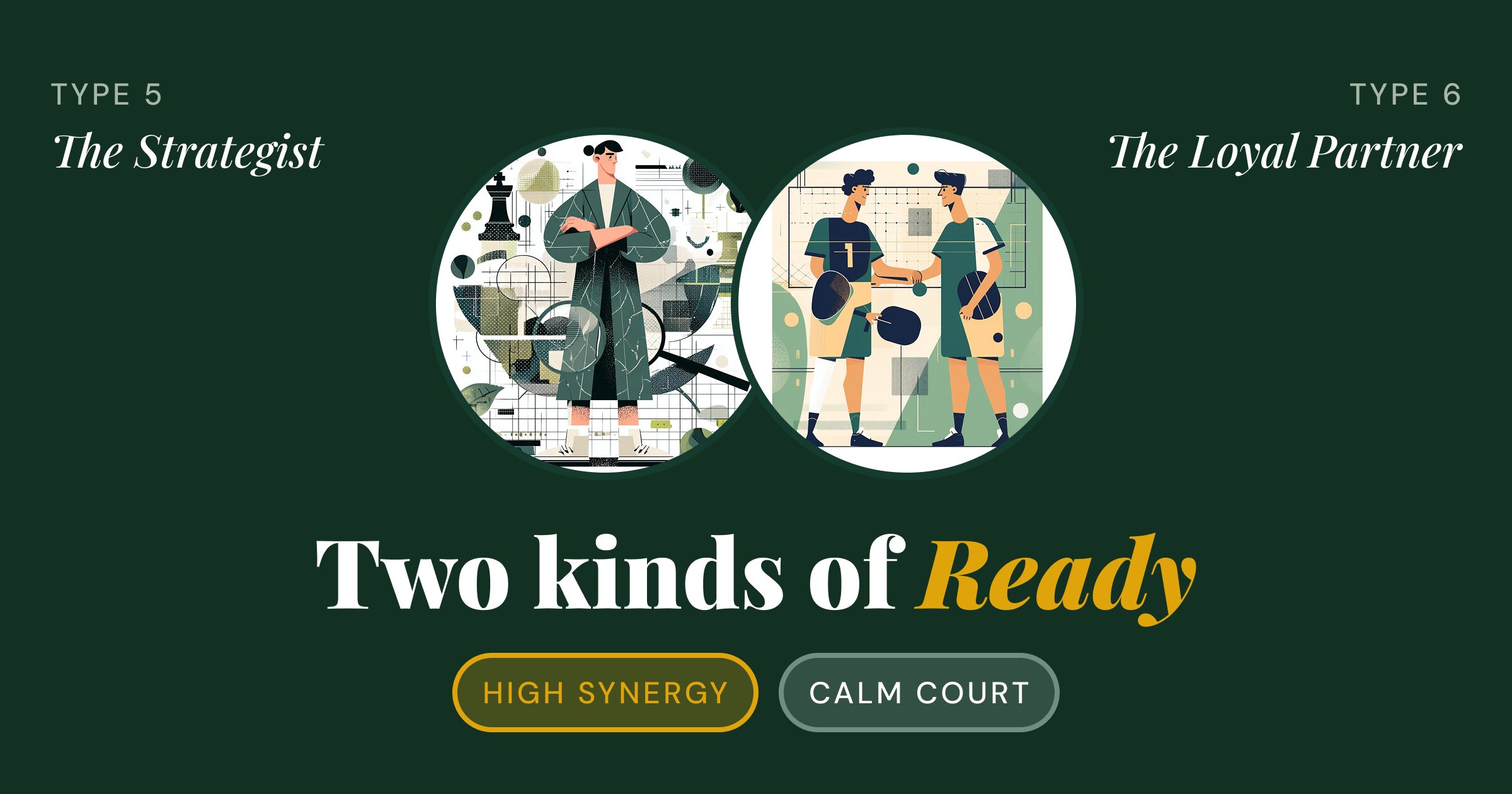
Court Chemistry Series · Type 5 × Type 6
Marco arrived to warm-ups fifteen minutes early.
He’d already watched film on their opponents — two videos, serve patterns, weak backhand, mapped a first-game strategy. When Jordan got to the court, Marco gave a single nod and started feeding balls from the baseline.
Jordan noticed the nod. Filed it away. Good — he’s focused. He’s not nervous. We’re okay.
They hadn’t talked about the match yet. They didn’t need to.
They went on to win — not because the game plan was perfect, but because neither of them second-guessed the other once. Jordan covered the middle without being asked. Marco called the adjustment at 8–8 without checking whether Jordan was on board. Jordan executed it.
Walking off the court, Jordan said: “Same time Thursday?”
Marco said yes.
That was the whole debrief.
So What’s Actually Happening Here?
The Strategist came to this partnership the way they come to everything: prepared. They’ve thought about the game, identified the angles, considered what’s likely to go wrong. They don’t spend a lot of time in emotion during a match. They spend it in analysis — quiet, focused, already three shots ahead.
The Loyal Partner came to this partnership the way they come to everything: attentive. They’re tracking their partner’s energy before they track the score. They notice when something’s off, when the team shifts, when the person beside them needs something. They show up ready to be reliable — and they need to know that the person they’re showing up for is genuinely capable.
This pairing works because those two things fit together in a way that isn’t obvious until you see it on the court. The Strategist’s competence is the most reassuring thing in the world to a Loyal Partner. The Loyal Partner’s attentiveness protects the Strategist from the one blind spot they carry: the partnership itself.
The Strategist on the Court
The Strategist’s gift is clarity under pressure. When the game gets complicated, they get quieter and sharper. They read patterns, call adjustments, and rarely make the same mistake twice. Their communication is precise: “Their backhand dink is weak — keep going there.” Not a pep talk. A data point.
The shadow is that this focus can read as detachment. The Strategist isn’t checked out — they’re conserving bandwidth. But a partner who doesn’t know that will spend the match trying to interpret silence, and what looks like calm focus can feel, from the outside, like indifference.
The deeper thing: the Strategist gives through competence. That’s how they care. They prepared for this match. They’ve already thought about what the team needs. They just rarely say any of that out loud.
The Loyal Partner on the Court
The Loyal Partner’s gift is vigilance — the useful kind. They catch things. A subtle shift in their partner’s energy. A pattern in the opponents’ positioning. The fact that something that was working three games ago has stopped working now. They’re attentive in a way that makes a team more adaptive without anyone quite knowing why.
The shadow is that vigilance without information becomes anxiety. The Loyal Partner’s background process is always running a quiet scan: are we okay, is this working, is my partner frustrated with me? When they have clear signals — good or bad — they can calibrate. When they don’t, they fill the gap themselves, and the fill is usually worse than the truth.
The deeper thing: what looks like worry is actually loyalty on high alert. The Loyal Partner doesn’t need the game to be perfect. They need to know the team is intact. Give them that signal, and they play with everything they have.
A Match You’ve Probably Seen (or Lived)
It’s game two, 7–8, trailing.
Marco has gone quiet in a way Jordan can’t fully read. Working through something? Frustrated? Jordan doesn’t know. Two points ago, Jordan hit one wide and has been slightly off-position ever since — not because of the miss, but because of the silence after it. Waiting for a reaction that hasn’t come.
Between points, Marco says: “They’re cheating right. We go behind them — sharp angle, back corner.”
That’s it. No “shake it off.” No “we’re good.” Just the adjustment.
Jordan pauses. He’s thinking about the game, not about me. Takes a breath. Resets.
They run the pattern. It works. Marco gives a single nod.
Jordan exhales.
That moment — one read, one call, one execution — is the whole partnership in miniature. The Strategist communicated through the game plan. The Loyal Partner learned to receive it that way. Neither person changed who they were. They just learned each other’s language.
When the Pressure Hits
Under real stress — a tight third game, a bad run of errors, a match that shouldn’t be this close — both types pull inward. Just in different directions.
The Strategist goes deeper into analysis. The processing accelerates; the external communication shuts down. Marco stops talking almost entirely, cycling through adjustments faster than he can implement them. His partner feels the silence thicken.
The Loyal Partner shifts from the game to the partnership. Jordan’s attention moves off the court and onto Marco — scanning for signs of blame, interpreting posture, reading micro-expressions. The game becomes secondary to the threat assessment: is he frustrated with me right now?
When both patterns activate at the same time, the team fragments without either person intending it. Marco locked in his head. Jordan watching Marco’s face. Two people on the same court, suddenly not playing together.
The reset is simple but requires intention: Marco offers one verbal anchor — “We’re good, stay with me” — and Jordan trusts it rather than interrogates it. Neither person has to become someone they’re not. They just need one small bridge.
When They’re Playing Their Best Game
At their best, this pairing is quietly formidable. Not loud. Not flashy. Precise, consistent, and genuinely difficult to rattle.
Marco reads the game and calls the adjustments. Jordan executes them and holds the emotional floor of the partnership. Neither player panics. Neither disappears. When something goes wrong, Marco thinks it through and Jordan stays present — steady in a way that makes it easier for Marco to think. When something goes right, there’s no celebration, just a nod and the next point.
Opponents underestimate them constantly. They’re not running the most aggressive game on the court. They’re running the most connected one.
What makes them effective isn’t just individual competence — it’s that they’ve built a shared language. Marco has learned to offer small verbal signals. Jordan has learned to read preparation as care. They’ve translated each other. That’s not a small thing. That’s the whole game.
Practical Takeaways
If you’re the Strategist:
Your preparation and focus are care — your partner just can’t always read them that way. One sentence between points costs you almost nothing and gives your partner everything. “Good read.” “We’ve got the next one.” “Stay with me.” You don’t have to perform emotions you don’t feel. You just have to occasionally narrate the game plan out loud. The partnership gets sharper when your partner feels included in it, not just subject to it.
If you’re the Loyal Partner:
The silence isn’t distance. The focused quiet isn’t frustration. Learn your partner’s signals — competence is their love language, and when they show up with a game plan, that is care. What you’re scanning for, you’ll find if you look in the right place. And ask for what you need directly. “Just tell me we’re good before we start” is a completely reasonable thing to say. Your partner can handle the request. They just need you to make it.
The reframe:
This pairing doesn’t need to generate more warmth. It needs to translate the warmth it already has. The Strategist is fully committed — they just don’t broadcast it. The Loyal Partner is fully trustworthy — they just need occasional confirmation. The work isn’t becoming more alike. It’s learning each other’s language. And these two, when they get there, tend to stick.
Try the Partnership Lab
Curious how your specific pairing plays out? The Partnership Lab breaks down your court chemistry in full — what works, what creates friction, and the one thing to say before you play.
Don’t know your type yet? → Take the QUEST
More Court Chemistry
Curious how your type plays with others? Explore the full series:
Leave a Reply