
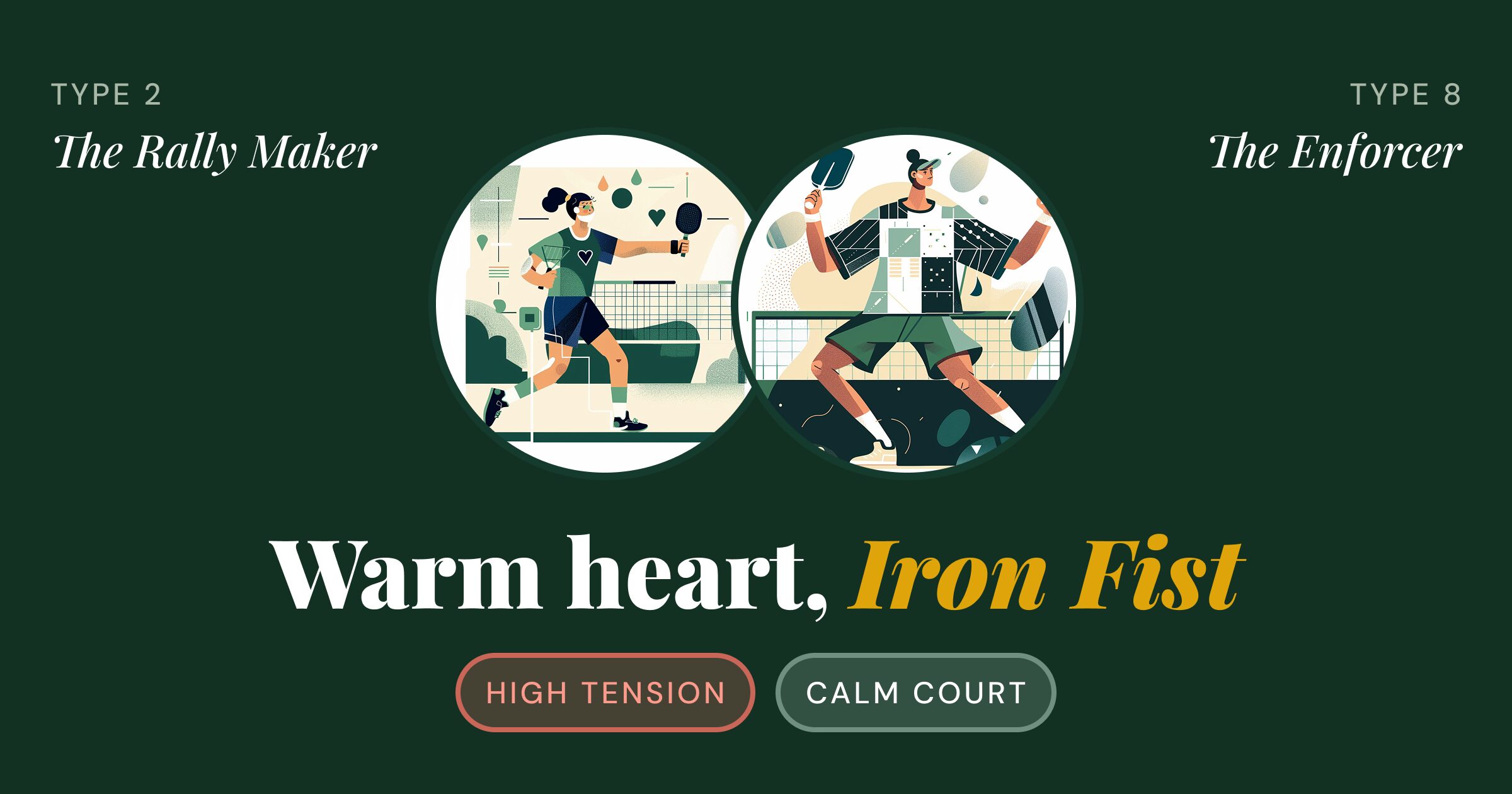
Court Chemistry Series · Type 2 × Type 8
Jordan is already at the net when Sam gets to the court, hitting drives at a ball machine, adjusting their grip between shots.
Sam drops their bag, starts warming up on the baseline. “Good drive,” Sam says, after a particularly clean one.
Jordan nods. Hits another.
They play well that morning. Jordan calls the shots — where to serve, when to speed up, when Sam should take the middle. Sam follows. It works. They win three games out of four.
Walking off the court, Jordan says, “Your net play was off today. You’re giving up too much ground.”
Sam nods. Files it away. Doesn’t mention that they’d played two hours yesterday and their shoulder is tight. Doesn’t mention that they gave up their preferred side, again, without being asked.
Jordan is already thinking about next week.
Sam is thinking about whether this is still fun.
So What’s Actually Happening Here?
The Rally Maker came to this partnership the way they come to all of them: ready to give. They’re the most partner-focused player in the game. They track your energy before they track the score. They cover the middle without being asked, celebrate your winners louder than their own, and absorb the emotional weather of a match without making it anyone’s problem.
The Enforcer came to this partnership the way they come to everything: ready to compete. They’re direct, physically commanding, and completely unfazed by their own intensity. They lead from the front. They expect a partner who can keep up — and they don’t spend a lot of time checking whether that’s still working for the person beside them.
This pairing can be devastatingly effective. It can also, quietly and without either person intending it, become one-sided in a way that doesn’t show up until it’s already done damage.
The Rally Maker on the Court
The Rally Maker’s gift is attunement. They read their partner — what they need, what’s landing wrong, where the team is leaking energy — with a precision that most players never develop. Their presence stabilizes a partnership. Partners who play with a Rally Maker often can’t fully explain why the experience feels so different until they play without one.
The shadow is that attunement without reciprocity becomes invisible labor. The Rally Maker covers the gaps, absorbs the intensity, adjusts their game to serve the partnership — and does all of it so seamlessly that their partner never has to notice. Which means their partner often doesn’t.
The deeper thing: the Rally Maker gives because they genuinely want to. But wanting to give is different from being okay with never receiving. And the Rally Maker will be fine — for a while. Until suddenly they aren’t, and by then it’s complicated.
The Enforcer on the Court
The Enforcer’s gift is force — physical, mental, directional. They protect their side of the court like it’s a matter of principle. They don’t leave shots in the middle wondering who’s going to take them. They dominate the net in a way that changes what opponents try. Their confidence is contagious when it’s working, and their recovery under pressure is something quieter partners spend years trying to build.
The shadow is that force without calibration becomes pressure. The Enforcer pushes hard in tone, expectation, and post-point intensity — usually without realizing it. They’re not trying to make their partner feel small. They’re just competing. But competing at full volume next to someone who is quietly absorbing everything creates an imbalance that doesn’t announce itself until it’s already become the dynamic.
The deeper thing: the Enforcer believes if something were really wrong, their partner would say so. Which is true for most types. It is not true for the Rally Maker.
A Match You’ve Probably Seen (or Lived)
They’re tied at 8–8 in the third game. Jordan starts driving harder, calling out adjustments between points — “Take the middle.” “Their backhand is gone.” “Stop resetting, we need pace.”
Sam follows all of it. Covers the middle. Adds pace. Doesn’t reset.
They go up 10–8. Jordan takes the next two points with backhand drives. Match.
Jordan pumps a fist. “Good adjustment.”
It’s the first thing Jordan has said to Sam that isn’t instructional in forty minutes.
Sam smiles. Means it, mostly.
On the drive home, Jordan replays the match — what worked, what didn’t, what to adjust next week. Texts Sam: “Next Thursday?”
Sam says yes.
And in the parking lot of that same court, two weeks from now, Sam is going to realize they haven’t called their preferred side once since this partnership started. They gave it up the first week without mentioning it. Jordan never asked, and Sam never said. It just became the arrangement.
Neither of them made that choice. It happened in the space between them, in all the small moments where Sam adjusted and Jordan assumed, until it felt too late to name.
When the Pressure Hits
When things get tight, the Enforcer gets more intense — harder shots, shorter feedback, higher expectation. They expect their partner to match the energy or at minimum get out of the way. This is how they compete. It’s effective and it’s completely legible to other Type 8s.
It is not always legible to the Rally Maker.
The Rally Maker under pressure goes inward. They’re managing their own performance, their partner’s emotional output, and the quiet suppression of anything they need that might slow things down. They keep covering. They keep adjusting. They look fine because they’ve decided to be fine, which is a different thing from being fine.
By the time the Enforcer notices something’s off — if they notice — the Rally Maker has already been carrying it alone for several points. Maybe several weeks.
When They’re Playing Their Best Game
The best version of this partnership runs on a specific exchange: the Enforcer leads with clarity and force, and the Rally Maker feels genuinely seen for what they contribute — not the way you appreciate a system that works, but actually noticed as a person making real choices.
The Enforcer doesn’t need to become soft. They need to become specific. “That coverage was exactly right.” “I needed you there and you were there.” Brief. Concrete. Out loud. That’s the whole thing.
And the Rally Maker needs to stop performing contentment they don’t fully feel. They need to say: “I want the left side this week.” “That landed harder than you meant it to — just flagging it.” “I need a minute after a loss before we debrief.” Small asks. Said early. Before the resentment has a reason to show up.
When both things are happening — the Enforcer’s visible appreciation and the Rally Maker’s honest self-expression — this stops being a transactional partnership and becomes something rare: a team where one person’s force and one person’s attunement are genuinely in service of each other. The Enforcer gets a partner who covers what they miss. The Rally Maker gets a partner who protects what they build.
It’s one of the best pairings on the court when it’s working. The work is making sure both people know it.
Practical Takeaways
If you’re the Rally Maker:
Your attunement is a gift — don’t turn it into a one-way system. Name your preferences before the match, not after. Distinguish between your partner’s intensity (normal for them) and something actually directed at you (worth naming) — those are different things, and treating them the same way will cost you. Your partner can handle hearing what you need. They just need you to say it. The partnership doesn’t get weaker when you show up as a full player. It gets real.
If you’re the Enforcer:
Visible appreciation is not optional in this partnership. The Rally Maker will continue covering for you regardless — that’s who they are — but the quality of what they bring shifts when they feel seen, and erodes when they don’t. Your directness is an asset; your delivery is the variable. And ask what they need. Once, before the match, and mean it. Not as a courtesy. As a genuine question.
The reframe:
This pairing doesn’t fail because the two types are incompatible. It fails because one person keeps giving and the other keeps not noticing. Fix the noticing — and the giving becomes something both people chose, which is a completely different partnership.
Try the Partnership Lab
Curious how your specific pairing plays out? The Partnership Lab breaks down your court chemistry in full — what works, what creates friction, and the one thing to say before you play.
Don’t know your type yet? → Take the QUEST
Leave a Reply