
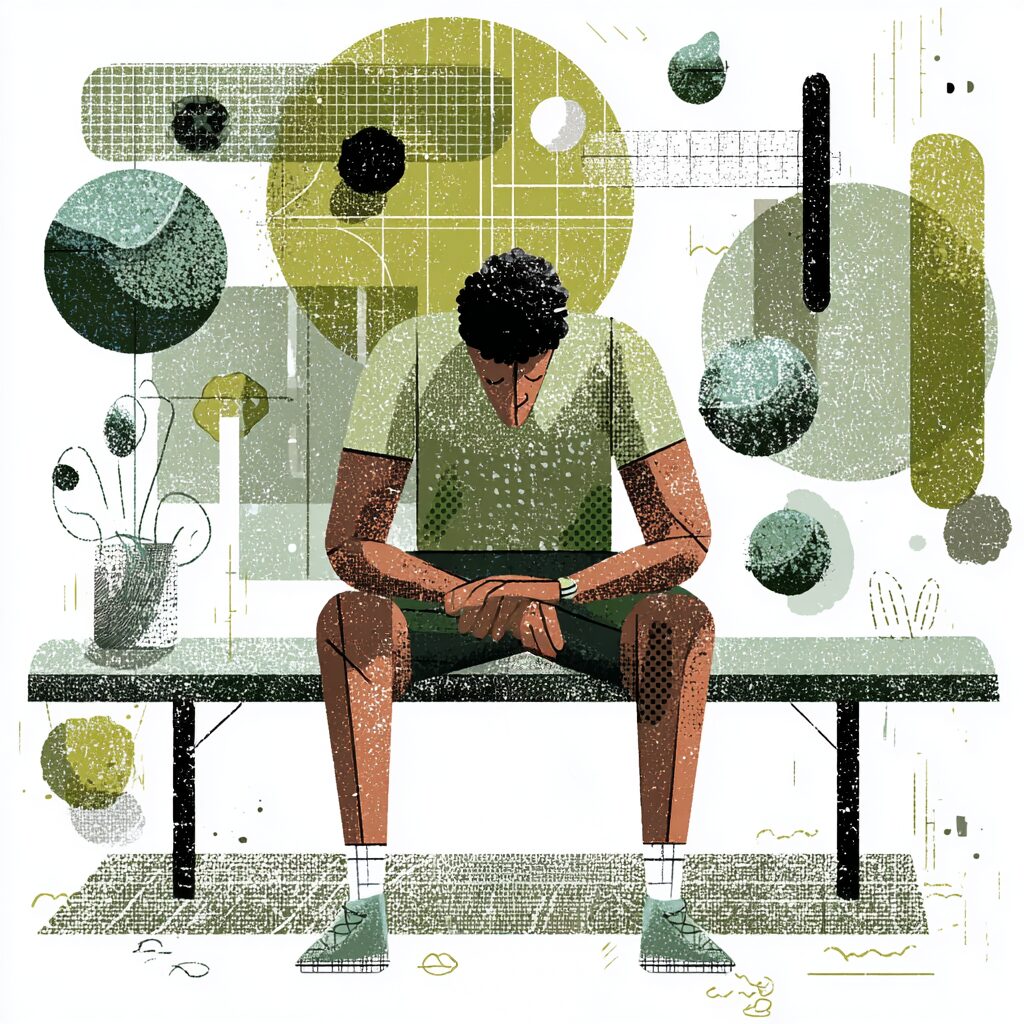
The walk back to your car after a match tells you more about your pickleball mental game than the scoreboard ever will.
Not because of what happened out there. But because of what’s happening inside you right now, on the way to your car, replaying it.
Maybe you’re cataloguing every error, running a quiet audit of everything that went wrong. Maybe you’re wondering if your partner is okay with you — if the friction you felt at the net changed something. Maybe you’re not sure what you’re feeling at all, just that something is sitting with you and you can’t quite name it.
The score is the same for everyone. But that walk? That’s different for every player.
And it’s telling you something worth listening to.
What is a growth edge, exactly?
In pickleball — and in life — your growth edge is the place where your personality pattern stops serving you.
It’s not a weakness. It’s not something broken. It’s the predictable, completely human way your wiring shows up under pressure, in partnership, and in the moments that matter most.
Every player has one. Most players never look at it directly. They chalk it up to a bad day, a difficult partner, the wrong conditions. They walk it off and show up the same way next week.
But the players who actually grow — on the court and off it — are the ones who get curious about that walk. Who ask: what is this moment showing me about myself?
That’s what a growth edge is. Not a flaw to fix. A pattern to understand.
Why pickleball reveals your mental game more than think
Here’s what makes pickleball uniquely revealing: you can’t hide.
In most sports, you’re either solo or lost in a team. Pickleball puts you in a two-person partnership, inches from your opponent, in a game that’s equal parts physical and mental — and it does all of this in a format that’s supposed to be fun.
That combination is a perfect storm for personality.
The physical closeness means your emotional weather is visible. Your partner feels it when you tighten up, check out, or start overcompensating. The social nature of the game means the stakes feel personal even when they’re not. And the doubles format means your patterns don’t just affect you — they ripple directly into the person standing two feet to your left.
Add a scoreboard, a little competition, and the pressure of not wanting to let your partner down, and suddenly you’re not just playing pickleball. You’re playing yourself.
The three patterns
After working with players across all nine pickleball personality types, three broad growth edge patterns tend to emerge. You’ll probably recognize yourself in one of them — and maybe catch a glimpse of your partner in another.
The Performers
These are the players for whom the game is tied to something deeper than winning. For The Closer, the scoreboard is a mirror — a bad match doesn’t just feel like a loss, it feels like a verdict. For The Line Judge, every error is filed, reviewed, and held to a standard that no one else is being held to. For The Enforcer, losing can feel like a threat, and the armor that goes up to protect against that threat can cost the partnership something real.
The gift of the Performer is drive, precision, and intensity. The growth edge is learning to separate what happens on the court from what it means about you.
The Feelers
These are the players for whom the relationship is the game. For The Rally Maker, showing up for their partner comes so naturally that they forget to show up for themselves — and slowly, quietly, their own game disappears. For The Artist, a rough match doesn’t just feel bad — it feels like proof of something. For The Loyal Partner, the match hasn’t even started before the worry has already run through every possible way it could go wrong.
The gift of the Feeler is attunement, loyalty, and emotional depth. The growth edge is learning that their own needs, feelings, and presence belong on the court too.
The Withdrawers
These are the players who manage the game from a slight distance — emotionally, energetically, or both. For The Strategist, all the preparation in the world can still leave them one step removed from actually trusting themselves to play free. For The Rally Cat, keeping the energy light is a genuine gift — until it becomes a way of avoiding the hard stuff. For The Anchor, the peace they maintain for everyone else can slowly erase their own game entirely.
The gift of the Withdrawer is steadiness, perspective, and an ability to hold space. The growth edge is learning to come fully forward — to take up the space the game is asking them to fill.
The growth edge isn’t the problem. Avoiding it is.
Here’s the thing about growth edges: they don’t go away because you ignore them. They just show up again next week. In the same moment, with the same partner, in the same situation that got you last time.
The court has a way of being very patient about this.
What changes when you actually look at your growth edge — when you get curious instead of defensive about the patterns that surface under pressure — is that you stop being run by them. You start to play with more freedom. Your partnerships get cleaner. The walk back to your car gets a little quieter.
Not because you’ve fixed something. Because you’ve understood something.
Which pattern is yours?
If one of the three resonated — or if you’re not sure — the QUEST quiz was built for exactly this moment. It takes two minutes, and it gives you a full picture of your pickleball personality: your gifts, your growth edge, and what it means for the partnerships you’re in.
And if you want to go deeper on your specific type, every growth edge post in this series lives in the Discover section — one for each of the nine pickleball personalities.
The court already knows your growth edge. Now it’s your turn.
Leave a Reply