
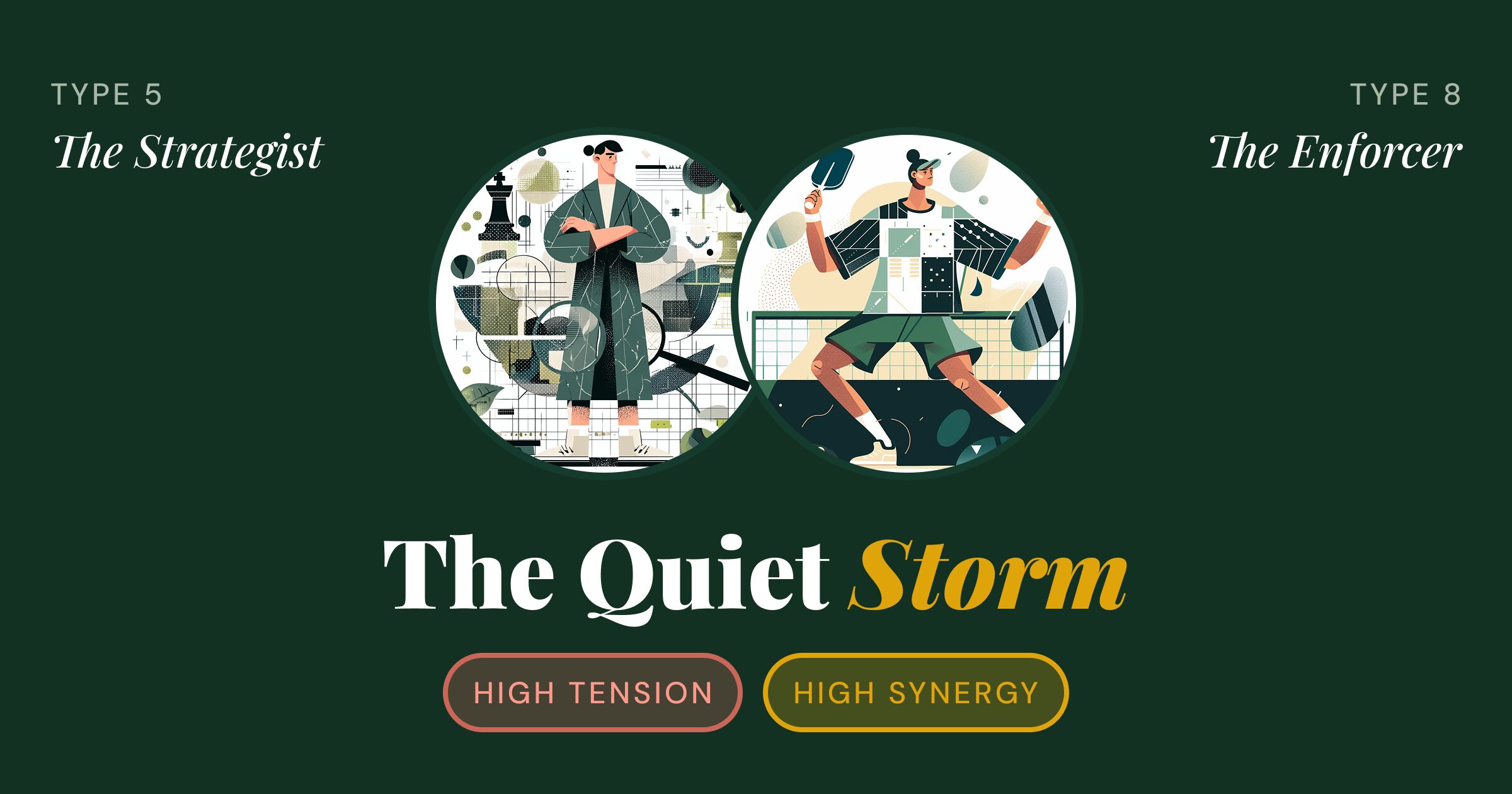
Casey had already watched them warm up.
Not obviously — just a few minutes at the baseline, tracking serve patterns, noting who covered the middle, clocking the backhand that was a half-step slower than it should be. By the time Jordan got to the court, Casey had a rough game plan assembled.
Jordan didn’t ask about it. Didn’t need to. They bounced on their toes, hit a few hard volleys at the back fence, and looked over once: “Ready?”
Casey nodded.
That was the entire pregame conversation.
They won the first game 11–5. Casey called one adjustment, at 5–3, in four words: “Go behind them — crosscourt.” Jordan didn’t ask why. Just did it. The pattern broke open.
Walking to the bench, Jordan said: “You saw that from the start, didn’t you?”
Casey almost smiled. “Pretty much.”
Jordan laughed once — short, satisfied. “Tell me sooner next time.”
“Fair.”
So What’s Actually Happening Here?
The Strategist came to this partnership the way they come to everything: having already done the work. They’ve observed, analyzed, mapped the angles. They know things about the opponent that the opponent doesn’t know about themselves. They don’t talk much on court — not because they’re disengaged, but because they’re processing. Every silence is full.
The Enforcer came to this partnership the way they come to everything: ready to move. They don’t need a full briefing before the first rally. They need a capable partner beside them and enough information to act. They trust instinct. They trust force. And when they trust their partner — really trust them — they become one of the most powerful players in the game.
What makes this pairing work, when it works, is that these two types have almost no overlap in how they operate. The Strategist sees the pattern; the Enforcer executes it. The Strategist doesn’t need to be the loudest voice on the court; the Enforcer doesn’t need to be the one with the game plan. Their competencies are genuinely complementary — the kind of fit that doesn’t require either person to change who they are.
The problem is timing. And trust. And the fact that both of those things have to be built on a court where neither player is naturally inclined to explain themselves.
The Strategist on the Court
The Strategist’s gift is pattern recognition under pressure. When the game gets complicated, they get clearer. They’re already tracking serve tendencies, identifying the weak return, noticing what the opponents do when they’re rattled. Their communication is sparse but precise — they don’t give pep talks, they give data points. And when they’re right — which is often — the data points win matches.
The shadow is that all of this happens internally, and the partner on the other side of the net can’t see any of it. The Strategist’s silence isn’t detachment. It’s focus. But partners who don’t know that will fill the silence with their own interpretation — and the Enforcer, who reads presence as commitment, may read that quiet as lack of urgency.
The deeper thing: the Strategist gives through competence. Showing up prepared, calling the right adjustment, protecting the team through analysis — that’s how they care. They’re unlikely to say any of that out loud. It just shows up in the outcome.
The Enforcer on the Court
The Enforcer’s gift is decisive action when action is required. They don’t deliberate at 9–9. They move, they call, they execute — and the certainty they bring to those moments is genuinely stabilizing for anyone who can receive it as support rather than pressure. They are completely present on the court. There is no part of the Enforcer that has checked out.
The shadow is that decisiveness can become a reflex that outruns the game plan. The Enforcer may call the middle ball before the Strategist has finished reading the point. They may adjust positioning based on instinct at exactly the moment the Strategist was about to recommend the opposite. They’re not wrong to act — they’re just acting on a different timeline than their partner.
The deeper thing: the Enforcer’s protection instinct is real. When they trust a partner, they fight for them. But trust is not given — it’s earned. And until the Strategist has demonstrated that their reads are reliable, the Enforcer will default to their own instincts. Which are good. Just not always better than the Strategist’s.
A Match You’ve Probably Seen (or Lived)
Third game. Score is 6–7, trailing.
Casey has identified the pattern. The opponents are soft on the left side — every time Jordan pushes wide, they get a weak reset. Three more of those and the game turns. Casey is cycling through the sequence, waiting for the right moment to call it.
Jordan is not waiting. Jordan has watched two errors in a row and decided something needs to change now. They start moving earlier, covering more court, forcing balls that aren’t quite there yet.
Casey notices. The pattern they were building starts to break down — the angles aren’t opening the way they were supposed to because the court positioning has shifted. Casey says nothing. Just recalculates.
Jordan, watching Casey go quiet, reads it as doubt. Are they checked out? Do I need to carry this? The coverage gets more aggressive. A ball at the centerline that Casey had covered — Jordan calls it anyway. Casey pulls up, late.
They lose the point. And the exchange that follows — a look, a pause, nothing said — carries more weight than either intended.
The read was right. The timing was off. And neither player said anything that could have fixed it.
When the Pressure Hits
Under real pressure, both types retreat to their defaults — and their defaults don’t naturally communicate with each other.
The Strategist goes deeper inside. The analysis accelerates; the external output drops to almost nothing. They’re not disengaging — they’re computing. But from the outside, especially to a partner who runs on action and visible intensity, it can look like the lights have dimmed.
The Enforcer goes bigger. More aggression, more calls, more court. When things aren’t working, their instinct is to apply more force. Which sometimes works. And sometimes overrides the very thing — the Strategist’s read — that would actually solve the problem.
So: Enforcer escalates. Strategist retreats further inside. Enforcer interprets that as confirmation they need to carry more. Strategist, now with less court to operate in, loses the vantage point they needed to see the pattern clearly.
It’s not a collapse. It’s a narrowing. Slow, quiet, and frustrating for both — because both players are doing exactly what they’re built to do, and it’s aimed in slightly wrong directions.
The intervention is almost laughably simple: the Strategist says one thing out loud. “I’ve got something — give me two points.” That’s it. The Enforcer, who was escalating because they felt the team was flying blind, suddenly isn’t flying blind. They can trust the reads again. They pull back just enough to let the plan run.
When They’re Playing Their Best Game
At their best, this team operates like a well-designed machine — quiet, efficient, and harder to beat than they look.
The Strategist runs the intelligence layer. They see the pattern, call the adjustment, identify the moment. They don’t need to be loud to lead — they just need to be believed. And when the Enforcer believes them, they are.
The Enforcer runs the execution layer. They take what the Strategist identifies and apply it with authority — the power shot at exactly the right moment, the net position that forces the error, the decisive call that closes out the rally. They make the Strategist’s reads matter by doing something real with them.
Together, they are the team that quietly dismantles opponents who thought they were winning. There’s no emotional weather on this court — no celebrations, no frustration spirals, no energy management required. Just two people doing their jobs with precision and trust.
What makes them dangerous, specifically, is that opponents can’t read them. There’s no visible friction to exploit, no emotional signal that the team is rattled. Casey and Jordan just keep playing. And playing well. In a format where a lot of teams beat themselves, this one simply doesn’t.
Practical Takeaways
If you’re the Strategist (Type 5) in this partnership:
Your reads are valuable — but they only help if they’re shared in time for your partner to use them. One sentence before the point starts is worth more than a perfectly constructed observation made after the rally is over. You don’t have to narrate everything. Just narrate the important thing, when it matters. “Watch their middle — it’s weak.” That’s enough. Your partner can take it from there.
Also: your silence is not neutral to your partner. It reads as something — often as doubt or disengagement. A small signal — a nod, a word, a brief acknowledgment after a good point — isn’t performance. It’s partnership maintenance. It costs you almost nothing and keeps your partner from filling the silence with a less accurate interpretation.
If you’re the Enforcer (Type 8) in this partnership:
Your partner is thinking. The quiet is full, not empty. Before you override their court position or call a ball they had covered, consider that you might be interrupting a process that was about to produce exactly what you needed. Give the Strategist two points to run a read before you escalate. If it’s not working, you can always take more. But you can’t unspend the trust you use when you take over.
Ask, once: “What are you seeing?” You don’t have to act on the answer. But asking signals that you’re a partner, not just a force — and that signal changes how much your partner will offer you going forward.
The reframe for both:
This partnership’s tension isn’t about competence — both players have plenty of it. It’s about timing and translation. The Strategist thinks faster than they speak. The Enforcer acts faster than they listen. The gap between those two speeds is where matches are lost. Close the gap — a word, a pause, a signal — and you have one of the most quietly formidable teams on the court.
Try the Partnership Lab
Curious how your specific pairing plays out? The Partnership Lab breaks down your court chemistry in full — what works, what creates friction, and the one thing to say before you play.
Don’t know your type yet? → Take the QUEST
More Court Chemistry
Curious how your type plays with others? Explore the full series:
Leave a Reply