
Quinn got to the court early — not to warm up, but to feel it out.
Something about the light, the way the courts were laid out, the particular quiet before people arrived. They stood there for a minute with their paddle, just taking it in. This mattered, somehow. The context of a match. Not just the score it would produce.
Sam arrived three minutes before start time, earbuds in, already running plays in their head. They gave Quinn a quick nod and started their warm-up routine — same footwork drill, same stroke sequence, same intentional reset pattern they always ran.
“You ready?” Sam asked.
“Yeah,” Quinn said.
Sam nodded and moved to the baseline. Quinn was still standing at the net, just for a second, just taking it in.
So What’s Actually Happening Here?
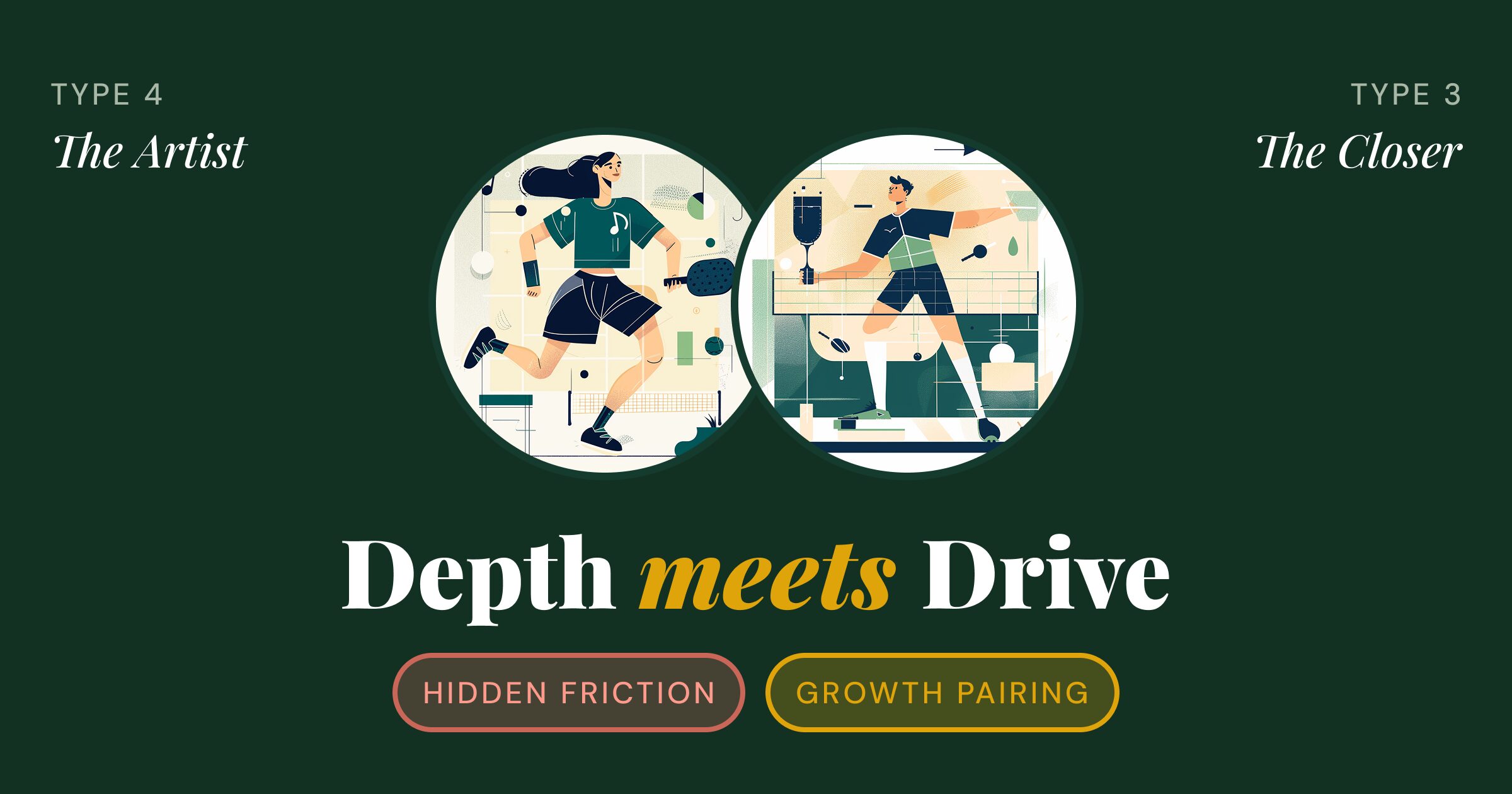
The Artist came to this partnership the way they come to everything: attuned. They feel the match before they play it — the texture of the day, the emotional undercurrent of the opponents, the unspoken things their partner is carrying. They’re not overthinking. They’re receiving. And what they’re always, quietly listening for is whether this partnership is real — whether the person across the net from them is actually present, or just performing presence.
The Closer came to this partnership the way they come to everything: driven. They’ve scoped the competition, calibrated their game plan, and set an internal target they haven’t told anyone. They’re not cold — they’re focused. The court is where they get to be good at something, and being good matters to them in a way that goes deeper than they usually let on.
Both are heart types. Both care more than they show. The difference is what they do with that caring under pressure — and that difference is exactly where this pairing gets interesting.
The Artist on the Court
The Artist’s gift is perception. They read the game at a level most players don’t — the emotional current of a match, the moment before the shift, the thing the opponent is telegraphing that nobody else has noticed. They play with a kind of instinctive creativity that can’t be taught, and they produce moments that make people stop mid-rally and watch.
The shadow is that this depth is also a liability. A bad game doesn’t just feel bad — it can feel like evidence of something. Like the errors meant something about them, not just about the point. When the Artist is in that spiral, they play smaller. Not slower — smaller. Like they’re protecting themselves from the verdict of a bad shot.
The deeper thing: what looks like sensitivity is actually an enormous capacity to feel the game. The Artist doesn’t need to stop feeling so much. They need a partner who doesn’t flinch at what that looks like.
The Closer on the Court
The Closer’s gift is performance under pressure. When the match tightens, they get sharper, not looser. They’re adaptable, composed, and wired to want the ball at 10–9. The court brings out something real in them — and they know how to use it.
The shadow is the mask. The Closer manages their image on court, often without realizing it. Not dishonestly — it’s just how they’re wired. The composure, the calibrated confidence, the way they project control even when the internal experience is something messier — it’s not performance for its own sake. It’s how they stay functional. But it reads to a perceptive partner as inauthenticity, and no one is more perceptive than an Artist.
The deeper thing: the Closer’s drive is real. The warmth underneath the performance is real. They just rarely let people see the second thing while the first one is running.
A Match You’ve Probably Seen (or Lived)
It’s game two, 5–8, trailing.
Sam goes into performance mode the way they always do when the scoreboard turns against them: sharper focus, tighter body language, controlled aggression. Every movement precise. Nothing wasted. They’re in it.
Quinn feels the shift immediately — and misreads it. The composure lands as shutdown. The precision feels like Sam has decided to carry this themselves, and Quinn is just supposed to fall in line. Quinn doesn’t say anything. They start playing smaller, pulling back from the instincts that make them good, because taking a creative risk right now feels like it won’t be received well.
Sam isn’t thinking any of that. Sam is competing.
They lose game two. Somewhere in the transition, Sam says — efficiently, helpfully — “We just need to reset and execute.”
Quinn nods. But something’s off. The word execute landed like a closing door.
Later, in the parking lot, Quinn says: “It felt like you stopped trusting me when we fell behind.”
Sam stares at them. “I trust you completely. I thought I was helping.”
They were both right. And they were playing the same match completely alone.
When the Pressure Hits
Under real stress — a tight third game, an error streak, a match that’s slipping — both types contract. Just differently.
The Closer tightens into the performance. The mask goes on tighter. Everything gets more controlled and more opaque. They’re not pulling away — they’re holding the team together the only way they know how. But what their partner sees is a closed door.
The Artist moves inward too, but toward feeling. The spiral starts quietly — a bad point becomes a pattern becomes a story about whether they’re actually good enough to be out here today. They’re not dramatic about it. They get quiet. They get small. And they stop playing the game that makes them valuable.
When both patterns run at the same time, the team doesn’t fight. It just… flattens. Two people going through the motions, each waiting for the other to show up.
The reset is a single sentence from the Closer — but it has to be a real one: not “we’re fine, execute the plan” but “I’m frustrated we’re down — what are you seeing out there?” That question opens a door. The Artist will walk through it every time.
When They’re Playing Their Best Game
When this pairing works — really works — it’s because the Closer has put down the mask. Not the drive. Not the competitiveness. Just the performance layer.
When the Closer shows up as actually themselves — uncertain sometimes, genuinely frustrated sometimes, willing to say “I don’t love where we are right now” — the Artist stops monitoring and starts playing. The creative shot appears. The instinctive read they’d been sitting on gets called. The Artist isn’t distracted by inauthenticity anymore, so their full perception goes to the court.
And when the Artist trusts the Closer enough to play their whole game — the creative risks, the emotional intelligence, the depth of court read that nobody else on the court has — the Closer gains something they can’t manufacture alone: a partner who sees the game at a different frequency. Who catches what the strategy misses.
Their ceiling is genuinely high. Getting there requires both of them to do the harder thing. The Closer has to be real. The Artist has to stop waiting for proof before they trust.
Practical Takeaways
If you’re the Artist:
Your instincts are an asset — but only if you play them. When you sense your partner going into performance mode, resist the pull to go quiet. Name what you’re noticing: “I need you present more than I need you confident right now.” That sentence alone can open the whole match back up. And when you get a creative read, play it. Even if it’s wrong, the partnership needs you in the game, not watching from the edge of it.
If you’re the Closer:
The mask doesn’t help your partner — it isolates them. The most useful thing you can do when you’re losing isn’t project control. It’s drop it just enough to let your partner in. Not defeat. Honesty. There’s a difference, and your partner knows exactly which one it is. Try: “I actually don’t love where we are right now. What are you seeing?” The Artist will give you something real. It will be better than the plan you were running alone.
The reframe:
The friction in this pairing isn’t a mismatch. It’s a mirror. The Closer is learning that performing for their partner is less useful than being real with them. The Artist is learning that a partner’s intensity isn’t the same as withdrawal. Both lessons are uncomfortable. Both are exactly right. And when they land — this pairing plays together in a way that’s genuinely hard to stop.
Try the Partnership Lab
Curious how your specific pairing plays out? The Partnership Lab breaks down your court chemistry in full — what works, what creates friction, and the one thing to say before you play.
Don’t know your type yet? → Take the QUEST
More Court Chemistry
Curious how your type plays with others? Explore the full series:
Leave a Reply