
Post 8 of 9 in the Dink Deeper Type Profile Series
You’re playing with Sam for the first time, and about halfway through the first game, you realize something: you’ve been having the match you wanted to have.
Not because you’re winning. Not because the shots are going in. But because the person beside you has somehow made the whole thing feel easy. The between-point energy is calm. There’s no drama when you miss. There’s no tension when they miss. Someone called a lob and Sam said “I’ve got it” with a certainty that made you immediately believe them.
Afterward, you try to articulate what made them so good to play with, and it’s harder than you expected. The presence. The steadiness. The way the court never felt bigger than the two of you.
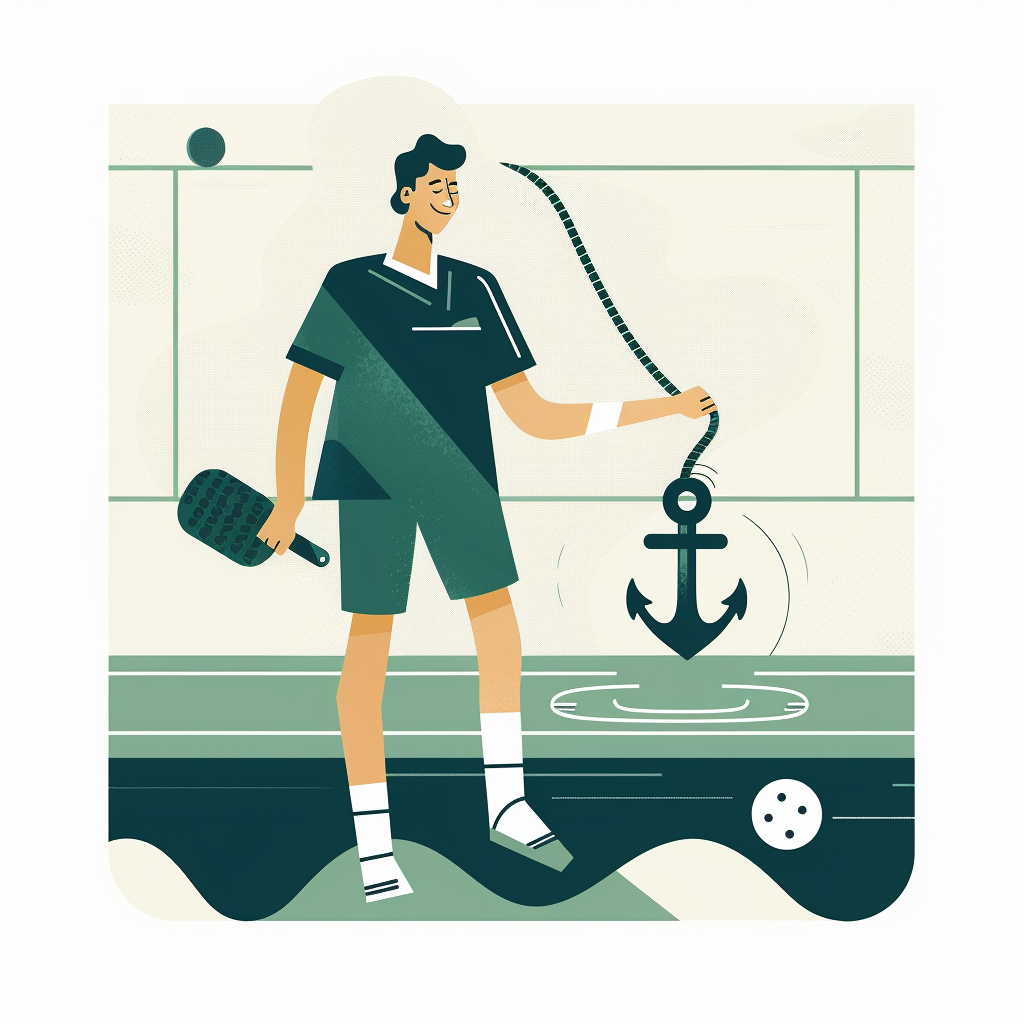
What you’re describing is what a Type 9 — The Anchor — brings to a doubles partnership. And it’s one of the most underrated gifts in recreational pickleball.
The harder part of the story — the one The Anchor hasn’t fully examined — is that this gift doesn’t come free.
So, Who Is The Anchor?
The Anchor is wired for peace. Not passivity — peace. There’s a genuine desire in them to keep things harmonious, connected, and free of unnecessary conflict. They have a gift for seeing multiple perspectives at once, which makes them unusually patient and slow to judgment. And they have an ability to merge with the environment around them — to slot into whatever the situation needs — that can look, from a distance, like easygoing flexibility. Which it is. And also sometimes isn’t.
What drives them: Connection, harmony, and a sense that everything is okay between themselves and the people they care about. They want the partnership to feel good — and they’ll work quietly to make it that way, usually without saying so.
What they’re quietly afraid of: Conflict. Disconnection. The particular discomfort of having their presence in the partnership feel like a burden or a problem. The Anchor’s deepest fear isn’t losing — it’s being the reason someone else is upset.
Their pattern on the court: Steady, calming, deeply reliable in ways that don’t announce themselves. Also: prone to going along with plans they don’t fully believe in, absorbing more than they let on, and disappearing when the emotional temperature gets high enough.
In everyday life, you probably recognize The Anchor as the person who:
- Never seems rattled in a crisis, which makes everyone around them calmer
- Has opinions but doesn’t often offer them unless directly asked
- Has a capacity for patience that outlasts almost anyone else in the room
- Has a hard time naming what they need — not because they don’t know, but because asking sometimes feels like making themselves a problem
The Anchor on the Pickleball Court
Doubles pickleball has an emotional weather system that most players don’t realize they’re creating. An error that lands wrong, a point of tension at the net, a partner who goes tight under pressure — all of it creates an atmosphere that affects how both players perform. The Anchor doesn’t just weather this; they calm it. They’re the reason a match that could have gotten tense stays manageable.
What they bring to a partnership:
- Steadiness that doesn’t depend on the score — they’re the same whether it’s 10-2 or 2-10
- Conflict-free communication that creates real safety for partners to make mistakes
- Patience in rallies that other types struggle to hold — they don’t force things
- An emotional intelligence that reads the partnership’s temperature and quietly adjusts
- The kind of reliability that makes a partner feel, at a gut level, that they’re not alone out there
The shadow side (every great player has one):
- Their preferences often go unstated — not because they don’t have them, but because offering them can feel uncomfortably like conflict
- They may defer to a partner’s game plan even when they see a better one, absorbing the friction of a wrong strategy rather than risking the friction of saying so
- Under enough pressure, The Anchor doesn’t fight through it — they go somewhere else. The lights stay on, the body is present, but the partner who needs them suddenly finds ambient nothing where their partner used to be
- Tactical contributions that stay invisible are tactical contributions that never improve the partnership
- The steadiness that’s their greatest strength can, if unchecked, become a kind of strategic passivity that costs them games they should have won
A Match You’ve Probably Seen (or Lived)
Sam is an Anchor. They’ve been playing for a year and a half, improve steadily without particularly trying to, and are everyone’s favorite drop-in partner — not because they’re the most skilled player in the group, but because you always leave feeling like it was a good morning.
Their partner, Riley, is intense. Competitive. The kind of player who plays every match like something is on the line even when objectively nothing is. Riley’s drive is part of what makes them a formidable player. It’s also, in the third game of close matches, a lot to be standing next to.
For most matches, Sam and Riley work well. Riley provides direction; Sam provides calm. But there’s a pattern that Sam has never named out loud: when Riley gets visibly frustrated — a tight call, two missed put-aways in a row, a lead evaporating — something happens to Sam. They stop talking. They stop offering reads. They execute their shots mechanically, avoid eye contact, give the tight smile when Riley tries to rally them.
Riley experiences this as Sam checking out. They try to pull Sam back in — “come on, let’s go, I need you here” — and get a nod that means nothing. It makes Riley push harder, which makes the temperature higher, which makes Sam go further in. By the end of the match, they’ve lost the thread entirely.
What Riley calls “Sam checking out,” Sam experiences as survival.
What’s really going on:
When the emotional temperature on the court climbs past a certain point, The Anchor doesn’t get fired up — they go somewhere safe. Not strategically, not as a choice they’re consciously making. The withdrawal is a reflex, a way of getting below the noise. They’re not abandoning Riley. They’re trying not to drown.
What they don’t see is that from Riley’s position, absence looks exactly like abandonment. And the withdrawal — even if it’s protective — removes the one thing the partnership most needs under pressure: Sam’s actual presence.
The question Sam hasn’t asked is: “What’s it like to be my partner when things get hard?” Not because they don’t care. Because asking might surface something uncomfortable, and for an Anchor, uncomfortable conversations are the hardest ones to start.
When the Pressure Hits
When an Anchor is under real pressure — a partner who’s visibly frustrated, a match that’s slipping, an emotional temperature that keeps rising — they get smaller. Not louder, not more assertive. Quieter. More careful. Less themselves.
The tactical suggestions they had stop coming. The calls they might have made get deferred to their partner. They’re still covering their side of the court, still executing the basics, but something essential has gone offline. The partnership loses access to half its brain.
Partners who respond by turning up their own energy — urging, rallying, pushing — typically get a tighter withdrawal in return. The Anchor doesn’t respond to pressure by rising to it. They respond to the temperature dropping first. Get quieter. Slow down. Then check in. That’s the signal that the space between you is safe again — and safe is the prerequisite for The Anchor coming back.
When They’re Playing Their Best Game
An Anchor at their best isn’t just the most grounding presence on the court. They’re something more complete than that.
The growth move for The Anchor is learning that their perspective is the partnership’s asset — not their burden. When a Strategist’s analysis stays internal, the partnership loses a weapon. Same thing happens when an Anchor’s read on the match, their preferred game plan, their honest reaction to a pattern that isn’t working, never reaches their partner. Steadiness is a gift. Steadiness that comes at the cost of The Anchor’s voice is a gift with a hidden price.
What it looks like when an Anchor levels up: they say “I see that differently” — calmly, without drama, just as a fact. They call the middle ball. They name the pattern that’s losing them the game before the game is over. They’re present in the partnership in a way that’s active, not just available.
A leveled-up Anchor is one of the most complete partners in recreational pickleball. The steadiness is still there. The calm is still there. But now it’s a chosen steadiness — rooted, not retreating. And a partner who can feel the difference will tell you it changes everything.
Practical Takeaways
If you are an Anchor — one thing worth practicing:
Before your next match, decide on one thing you’ll offer your partner without waiting to be asked. A tactical read. A preference for which side you play. An observation about the opponents you noticed warming up. Just one. You don’t have to make it a production — it can be completely casual. The point is that you said it because you thought it, not because someone made the space first.
The Anchor who practices this discovers something interesting: the partnership doesn’t fall apart when they take up space. It gets better. Their steadiness is still there. The partnership just now has both people in it.
If you play with an Anchor — how to actually reach them under pressure:
Lower the temperature first. Whatever your instinct says — to rally them, to push, to raise the energy — reverse it. Get quieter. Slow down. Then ask: “What are you seeing?” Not as a pivot back to strategy. As an actual question that means you want to know.
This does two things: it signals that the space is safe, which is the prerequisite for The Anchor coming back. And it asks them to contribute — which is the thing they’re not doing, and the thing they actually want to be doing if they knew how to say so.
The reframe:
An Anchor’s peace-keeping isn’t avoidance — it’s a genuine contribution to the partnership’s emotional health. The steadiness is real. The care is real. The growth edge isn’t learning to care more; it’s learning that caring includes showing up as themselves, not just holding the space for their partner. The partnership doesn’t need them to disappear into it. It needs them to be fully in it.
Court Chemistry: Playing With (or Against) a Type 9
Every pickleball personality brings something different to a partnership — and how an Anchor pairs with each type is its own story. Some combinations draw The Anchor into full presence immediately; others are where the withdrawal pattern lives.
We cover all of it in the [Court Chemistry Guide →] — a full breakdown of how The Anchor pairs with every pickleball personality type, including the one conversation to have before you play together.
Already know your type? Try the [Partnership Lab →] to generate a personalized compatibility report for you and your partner.
Not sure what your pickleball personality type is yet? Take the QUEST — a two-question quiz built specifically for pickleball players. Link in bio.
— Dink Deeper
Leave a Reply